
The danger of assuming we mean the same thing.
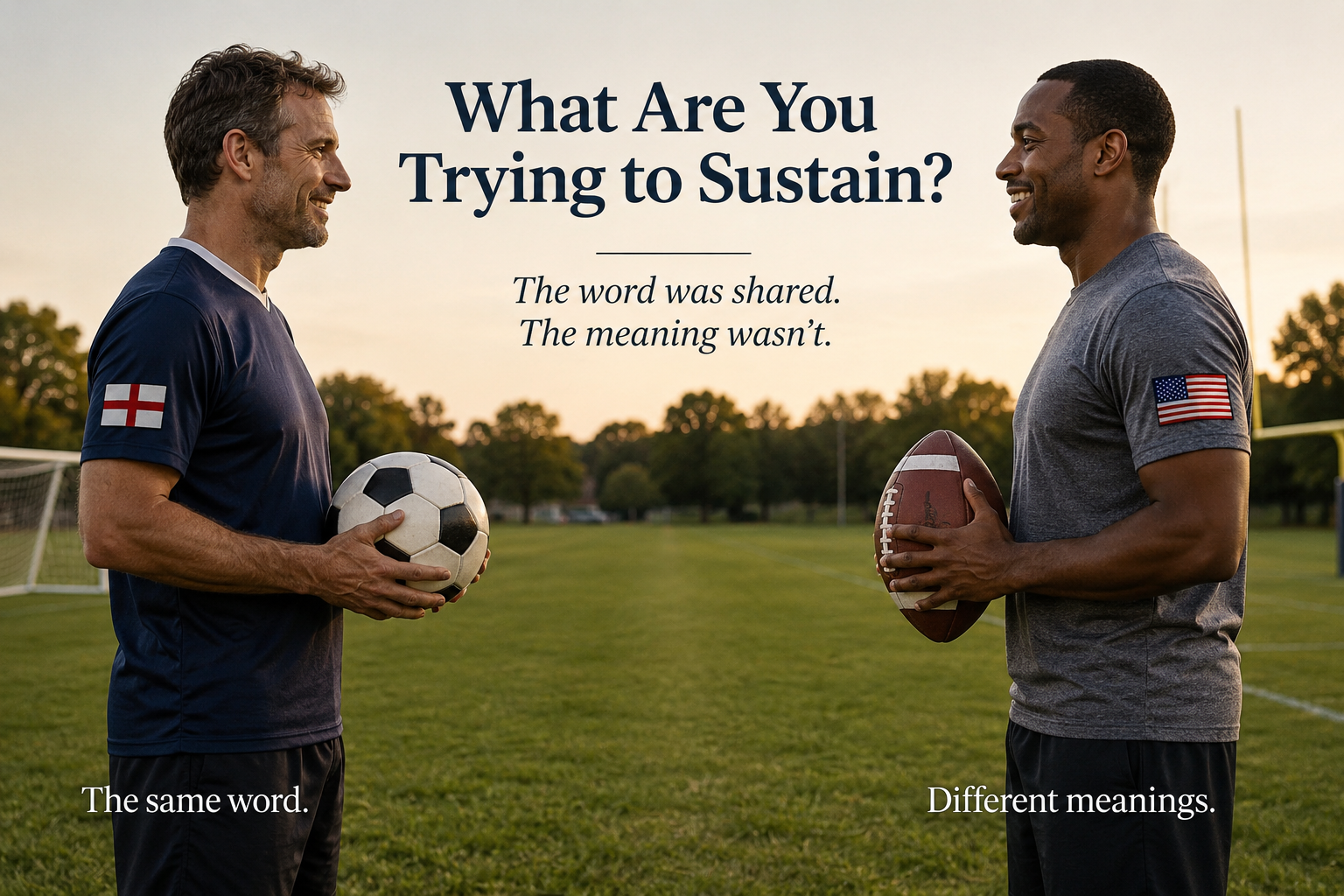
Imagine I invite you to play football after work.
As an Englishman, I arrive carrying a round ball.
As an American, you arrive carrying an oval one.
Neither of us is wrong.
Neither of us misunderstood the invitation.
We both understood the word football.
The problem is that we attached different meanings to it.
For most of the world, football means the game played with a round ball. In the United States, football means something else entirely.
The word was shared.
The meaning wasn’t.
I have come to believe something very similar has happened with sustainability.
For nearly forty years, governments, businesses, universities, investors, consultants and campaigners have all used the same word.
Sustainability.
It appears in reports.
Strategies.
Frameworks.
Policies.
Investment decisions.
Board materials.
Artificial intelligence now uses it fluently as well.
Yet remarkably few people stop to ask a simple question.
Do we all mean the same thing?
Begin with the word
Every important inquiry should begin with language.
Not because language solves the problem.
But because language determines whether we are even talking about the same problem.
So the proper place to begin is not with business.
Not with policy.
Not even with the Brundtland Report.
It is with the English language itself.
As a word, sustainability describes the ability to continue something over time.
That is complete as a general definition.
It tells us what the word means.
But dictionaries describe the general case. They do not tell us what is being sustained. Nor do they tell us for how long.
Those questions arise only when we apply the word to something.
Sustainable development.
Sustainable business.
Sustainable agriculture.
Sustainable finance.
Sustainable cities.
Sustainable packaging.
The moment we add the second word, we have changed the conversation.
We are no longer discussing sustainability in the abstract.
We are making a claim about something specific.
And that claim requires two questions.
What are you trying to sustain?
And for how long?
Why the questions matter
Those questions are not rhetorical.
They are structural.
Without answering them, sustainability remains an attractive word that different people can fill with different meanings.
A company may be trying to sustain profitability.
A government may be trying to sustain development.
A city may be trying to sustain employment.
A community may be trying to sustain a way of life.
An ecosystem may be trying to sustain its capacity for renewal.
All may be legitimate concerns.
But they are not the same concern.
And they do not necessarily operate over the same time horizon.
That is why the questions matter.
They force us to name the object.
They force us to name the horizon.
They force us to examine whether the thing we are trying to sustain is worthy of being sustained—and whether sustaining it undermines the conditions on which something more important depends.
The communication assumption
One of the greatest obstacles to transformation is not disagreement about solutions.
It is the assumption that familiar words carry shared meanings.
Sustainability may be one of the most important examples.
We have spent decades building frameworks, metrics, reports and strategies on top of a word whose application has often remained ambiguous.
That ambiguity matters.
If one leader hears sustainability and thinks primarily about compliance, another hears it and thinks about long-term resilience, another hears it and thinks about brand reputation, and another hears it and thinks about humanity’s responsibility to the living world, then the same conversation is not actually the same conversation.
Everyone may leave the room believing they agreed.
But they may each be carrying a different ball.
What sustainability asks
Over time, I have come to believe that sustainability is not itself an objective.
It is a property.
It describes the capacity of something to continue.
The real question has always been:
What should continue?
And then:
For how long?
Those two questions have become the foundation of much of my work.
They are also where the inquiry becomes uncomfortable.
Because once we ask them honestly, we begin to see that much of what business has called sustainability has often meant sustaining the business, the model, the market, the supply chain, the growth plan, or the permission to continue operating.
Those things matter.
Business matters.
Economic vitality matters.
Human prosperity matters.
But they are not the final object.
They are nested inside something larger.
The conditions required for life to continue.
Required.
Not preferred.
Not optional.
Required.
A declaration
After more than forty years of observation, I have come to believe this:
Sustainability, applied at the level that matters most, is the remembering of humanity’s responsibility to steward the conditions required for life to continue.
That responsibility did not begin with the modern sustainability movement.
It is older than corporate reporting.
Older than ESG.
Older than the circular economy.
Older even than the word sustainability as we now use it.
It appears across wisdom traditions, philosophy, Indigenous knowledge, ecology and systems science.
The language differs.
The responsibility remains.
We did not invent this idea.
We forgot it.
And if business is to play its necessary role in the future, it must help remember it.
What comes next
Next week, I want to examine one of the most influential documents of the last forty years.
Many people believe the Brundtland Report defined sustainability.
It did not.
It defined sustainable development.
And even there, the part most people quote is only the beginning.
The definition contains two concepts.
And a hierarchy.
That difference may explain far more about the last forty years than we have yet understood.
A question worth carrying
Before we build another framework.
Before we adopt another reporting standard.
Before we ask artificial intelligence to generate another sustainability strategy.
Pause for one moment.
Ask two questions.
What are you trying to sustain?
And for how long?
Everything else follows from there.
Continue the Inquiry
If this essay raised more questions than it answered, that was intentional.
Every Tuesday I publish a new edition of The Inquiry—a public exploration of the questions that have shaped my work for nearly five decades.
Subscribe to receive next week’s essay.
Looking Ahead
This essay is part of a larger inquiry leading to the publication of my forthcoming book:
Our Common Future—Now: Why Sustainability Reached a Ceiling—And What Comes Next
The conversation begins this September with its public launch in London and continues through 2027 as we approach the fortieth anniversary of the publication of Our Common Future.