
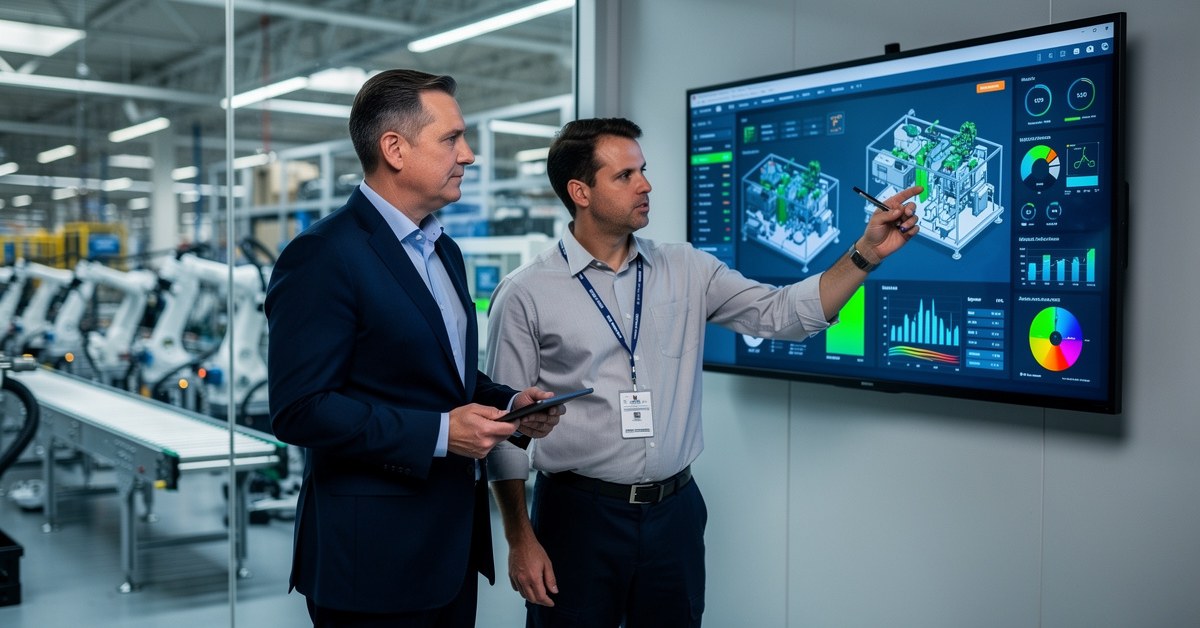
Digital Twin in Manufacturing: Strategy, Risk, and Value
The manufacturing sector stands at a critical inflection point. Digital transformation is no longer optional, and digital twin in manufacturing has emerged as one of the most powerful tools for executives seeking structural change. This technology offers more than operational visibility. It provides a framework for diagnosing hidden risks, testing decisions before implementation, and aligning industrial operations with regenerative business principles.
Why Digital Transformation Now Depends on Better Manufacturing Intelligence
Digital transformation in manufacturing is not a software upgrade. It is a fundamental shift in how organizations understand their operations, manage risk, and make strategic decisions. Leaders who treat it as a technology project rather than a business model redesign often find themselves with dashboards that look impressive but deliver limited value.
The convergence of digital and sustainability imperatives creates both opportunity and complexity. Research shows that a one-standard-deviation increase in digital transformation capacity corresponds to a 9.8% improvement on typical ESG scales. This connection is strongest in manufacturing and service sectors, where operational visibility directly impacts environmental performance.
- Manufacturing intelligence provides the visibility needed to identify inefficiencies before they become costly problems
- Better data infrastructure enables scenario planning that tests decisions without risking physical assets
- Digital twin in manufacturing creates a decision environment where leaders can evaluate impact before investment
- Operational visibility supports sustainability claims with verifiable data rather than surface-level reporting
What Digital Twin Technology Means in a Regenerative Context
A digital twin is a virtual model of a physical asset, process, or production system. It uses real or near-real-time data to help teams monitor performance, test scenarios, and make better decisions before changing the real operation. This differs fundamentally from dashboards, static simulations, or traditional automation tools that only show what has already happened.
In a regenerative context, digital twin technology becomes a diagnostic tool for understanding how your business operates within the broader conditions required for life. It reveals whether you are optimizing a machine that was never designed to sustain life, or whether you are redesigning the system itself. This distinction matters for leaders committed to the Design Like Nature™ system.
- Asset twins model individual equipment or machinery for predictive maintenance and lifecycle management
- Process twins simulate production workflows to identify bottlenecks and optimize throughput
- Factory twins represent entire facilities, enabling scenario planning for energy use and capacity
- System twins integrate multiple layers to reveal how decisions cascade across the organization
How Digital Twin in Manufacturing Is Being Used Today
Manufacturers are deploying digital twin technology across production planning, line balancing, equipment health monitoring, energy management, and supply chain resilience. Executives use twins to test decisions before making costly changes in the physical plant. This capability reduces risk while accelerating the pace of innovation.
The strongest value typically comes from reduced downtime, faster decisions, and more confident capital planning. Digital twins also support sustainability targets by identifying waste, energy intensity, and underused capacity. Organizations leveraging technologies like data analytics, the Internet of Things, and cloud computing can optimize energy consumption and minimize waste while enhancing operational efficiency.
- Production planning uses twin simulations to test scheduling changes before implementation
- Equipment health monitoring enables predictive maintenance that prevents unexpected failures
- Energy management identifies consumption patterns and opportunities for efficiency gains
- Supply chain resilience testing evaluates disruption scenarios and alternative sourcing options
Key Trends Shaping Digital Transformation in Manufacturing
The landscape of digital transformation is evolving rapidly. Connected assets, industrial data platforms, AI-enabled analytics, and simulation-led planning are becoming standard expectations rather than differentiators. More manufacturers are combining operational technology, IT, and sustainability data in one decision environment.
The shift from isolated pilots to integrated transformation programs marks a maturation of the field. Organizations that succeed recognize that digital twin technology requires governance, data quality, and clear ownership before deployment scales. The World Economic Forum playbook recommends that leaders integrate sustainability strategies across seven dimensions of their digital transformation roadmaps to ensure resilience and competitiveness.
The Business Case: Where Digital Twins Create Value and Where They Fail
The business case for digital twin in manufacturing breaks down into cost, resilience, quality, speed, and sustainability benefits. Organizations that succeed treat the twin as a decision support tool rather than a technical showcase. The model must support a real decision, not exist as an isolated capability.
Common failure modes include poor data quality, unclear use cases, unrealistic expectations, and weak cross-functional alignment. Technology alone cannot fix a broken business model. Leaders must assess whether they are trying to optimize an outdated model or redesign a viable one using frameworks like the Tactical Tetrahedron.
- Value creation comes from reduced downtime, faster decision cycles, and more confident capital planning
- Sustainability benefits emerge when twins identify waste, energy intensity, and underused capacity
- Failure occurs when data is unreliable, use cases are unclear, or ownership is ambiguous
- Success requires alignment between the twin, the decisions it supports, and the business strategy
What Leaders Should Ask Before Investing in Digital Twin Technology
Before committing to digital twin technology, leaders should examine their organization’s readiness and strategic alignment. The questions below help assess whether the investment will create value or become another expensive dashboard. This diagnostic mindset is essential for executives who want technology to serve a regenerative, life-aligned business model.
- What specific business decision will this twin support, and who owns that decision?
- Is the data reliable enough to inform the decisions the twin is meant to support?
- Does the model reflect the actual operating system of the business, or a simplified technical version?
- How does this investment align with our sustainability claims and long-term strategy?
- Are we optimizing an outdated model, or redesigning a viable one for the future?
- What governance structure will ensure data quality and clear ownership as we scale?
- How will we measure return on investment beyond operational efficiency metrics?
FAQ About Digital Twin in Manufacturing
What is a digital twin in manufacturing?
A digital twin in manufacturing is a virtual model of a physical asset, process, or production system. It uses real or near-real-time data to help teams monitor performance, test scenarios, and make better decisions before changing the real operation.
How does digital twin technology support digital transformation?
Digital twin technology supports digital transformation by giving leaders a decision environment they can use to understand operations more clearly. It can improve visibility, reveal inefficiencies, and help teams evaluate the impact of changes before they invest in them.
What are the main benefits of digital twin in manufacturing?
The main benefits typically include better visibility, lower downtime risk, improved planning, faster scenario testing, and stronger operational control. In some cases, it can also help identify waste and energy use that support sustainability goals.
What should leaders check before adopting digital twin technology?
Leaders should check whether the use case is clear, whether the data is reliable, and whether the team owns the decisions the twin is meant to support. They should also test if the model reflects the real business, not just a simplified technical version of it.
Relaunch: Leading the Future of Sustainable Manufacturing
The strategic imperative of adopting digital twin in manufacturing is clear. Technology must serve a regenerative, life-aligned business model. Leaders who treat digital transformation as a system redesign rather than a technology project will find themselves better positioned for resilience and competitiveness.
At Circularity Edge, we help executives assess their readiness and map the gap between current operations and future resilience. The sustainability strategy diagnostic provides a structured approach to understanding where your business stands in the Design Like Nature™ system. This is the safest, smartest, and most strategic place to begin for those ready to stop tinkering and start transforming.
The future is watching. Your grandchildren are watching. What will they say you built? The choice is yours. You can continue optimizing systems that were never designed to sustain life, or you can redesign with nature’s laws and lead what comes next.