

Executive teams and corporate boards frequently treat ESG and corporate social responsibility as a defensive, compliance-driven exercise. When sustainability functions face restructuring or downsizing, leadership often defaults to maintaining polished annual reports and tracking basic carbon metrics. This surface-level activity ignores the deeper, more dangerous structural risks embedded directly within the core business model. Treating sustainability as a separate reporting function rather than a central business reality creates a dangerous illusion of security. Eventually, the gap between public commitments and actual operational realities widens, exposing the organization to profound strategic failure and unmanaged liabilities.
The expectations surrounding corporate sustainability are shifting rapidly, leaving many leadership teams exposed. Traditional reporting frameworks and standard metrics consistently fail to reveal the hidden assumptions that actually drive organizational behavior. When companies rely on generic playbooks or AI-generated sustainability outputs without auditing the underlying logic, they risk reproducing outdated, flawed beliefs. We must move past optical responsibility. True executive oversight requires diagnosing the actual, unexamined risks that threaten long-term viability, especially when internal sustainability teams have been reduced and institutional knowledge has been lost.
This analysis explains exactly why traditional scoring mechanisms miss these existential risks and outlines how leadership can accurately diagnose the actual gaps in their current strategy. We will explore specific diagnostic frameworks, including the Design Like Nature system and the concept of Sovereign Sustainability, which serve as practical tools for genuine system redesign. By making invisible constraints visible, CEOs and founders can stop funding disconnected activities and start transforming their fundamental business architecture to align with the realities of a constrained world.
The Limitations of Traditional ESG and CSR Metrics
Standardized frameworks for ESG and corporate social responsibility metrics heavily rely on self-reported data, which is easily manipulated, frequently misunderstood, and often disconnected from core operations. These rating systems almost exclusively measure lagging indicators. They track past performance and historical compliance rather than evaluating the future resilience of the business model itself. The result is a flat, compartmentalized model that completely fails to capture the complexity of a living business system. When boards rely on these simplified scores, they remain blind to the structural vulnerabilities that sit just beneath the surface of their operations.
Far too many organizations still treat social responsibility corporate social responsibility as an extension of public relations rather than a mandate for fundamental system redesign. This misunderstanding creates a massive, unmanaged gap between public-facing commitments and the actual mechanics of how the company generates revenue. When sustainability functions are restructured, this gap often widens unnoticed. The following limitations highlight exactly why this superficial approach is entirely insufficient for modern leadership teams tasked with navigating real-world constraints and complex market demands.
- Reliance on self-reported data that lacks rigorous third-party verification or deep structural auditing
- Focus on lagging indicators and historical compliance instead of leading resilience signals that protect the business model
- Treatment of sustainability as an isolated cost center rather than a competitive catalyst integrated into core operations
- Failure to account for the hidden belief architecture and unexamined assumptions operating within the executive team
- Inability to detect structural misalignments between public sustainability claims and the actual mechanisms of profit generation
Hidden Belief Architecture: The Root of Sustainability Failures
When organizational transformation hits a sudden ceiling, the root cause is rarely a lack of resources or technology. The blockage almost always stems from unexamined beliefs about continuous growth, the role of nature, or the fundamental purpose of the business itself. We define this underlying structure as Belief Architecture. This architecture governs the operative, often invisible beliefs that dictate an organization’s actual capacity for change. Traditional ESG and CSR scores measure surface-level activity and output. They completely ignore the underlying belief systems that authorize, limit, or misdirect that activity in the first place.
Genuine business transformation requires a rigorous examination of these embedded beliefs, rather than the endless optimization of disconnected metrics. The Belief Architecture Diagnostic functions as a specialized tool to map these exact gaps, revealing the invisible constraints and responsibility boundaries that hold your business back from meaningful progress. We partner directly with leadership to make these hidden assumptions visible. Without addressing these foundational beliefs at the board and executive level, any subsequent sustainability effort will remain entirely superficial, highly vulnerable to market shocks, and ultimately ineffective.
From Linear Extraction to Living Systems: The Design Like Nature Approach
The Design Like Nature system provides a regenerative cycle that replaces the standard, linear compliance checklist. It shifts the organizational focus from simply doing less harm to actively pursuing regenerative growth by studying and mimicking nature’s 3.8 billion years of successful research and development. This biological approach contrasts sharply with the outdated linear extraction model, which relies on a fragile sequence of extracting resources, producing goods, selling them, and discarding the waste. Modern businesses can no longer afford the hidden costs and massive risks associated with that linear mindset.
This diagnostic system directly addresses the structural mismatch that standard reporting scores entirely miss by focusing on the mechanics of living systems. It forces the integration of ecological realities into the absolute core of the business model, rather than treating environmental concerns as a parallel, easily discarded add-on function. When companies restructure, they need a framework that survives organizational changes. The following seven pillars guide this deep transformation process, helping leadership teams build strategies based on reality rather than corporate fiction.
- REVIEW: Reveal what is actually happening beneath the surface of your current sustainability commitments and operational realities
- REFRAME: Shift the internal narrative from viewing sustainability as a compliance cost center to recognizing it as a competitive catalyst
- REFLECT: Examine the truth of your organization culturally, systemically, and soulfully to identify deep misalignments
- REDUCE: Strip away the excess reporting noise, eliminate disconnected initiatives, and simplify your strategy to clarify your actual goals
- REDESIGN: Architect a new operational system designed to be circular, fractal, and responsive to living constraints
- REPOSITION: Tell a truer, more accurate story to the market and back it up with undeniable operational reality
- RELAUNCH: Bring the redesigned, resilient future of your business model into the active market
The Tactical Tetrahedron: A 3D Operating System for Life-Aligned Strategy
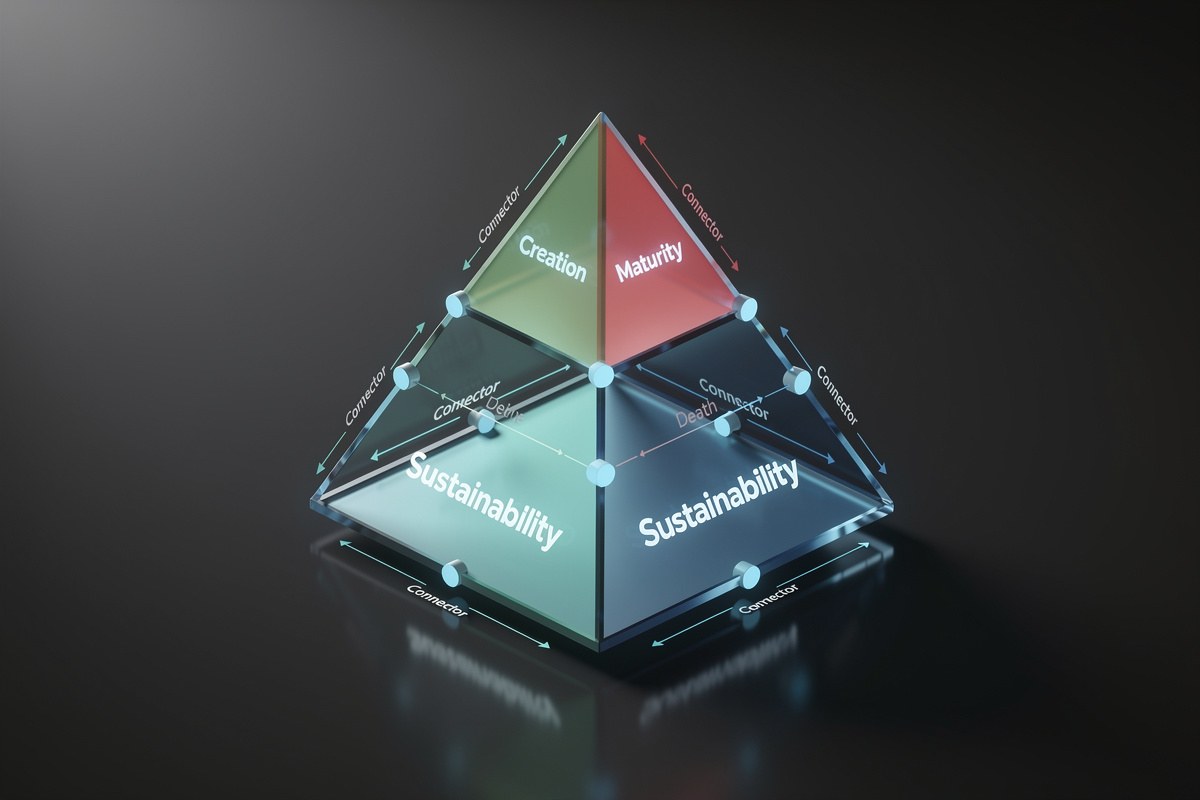
The Tactical Tetrahedron represents nature’s first inherently stable three-dimensional structure, featuring four distinct faces and six necessary connectors. Within our diagnostic framework, we define these four faces as Creation, Growth to Maturity, Aging to Death, and finally, Sustainability acting as the foundational base. This fractal, interconnected model allows executive teams to visualize how their business can sustain both the enterprise itself and the external conditions required for life simultaneously. It forces leaders to acknowledge the complete lifecycle of their operations, including the often-ignored phases of decline and renewal.
This three-dimensional model completely transcends the flat, disconnected bucket model found in traditional ESG and corporate social responsibility reporting. It directly connects executive decision-making to the two fundamental meta-strategies governing all living systems: clearly defining what we want more of, and ruthlessly identifying what we want less of. By applying this specific framework during a structural audit, leaders can finally align their corporate strategy with the actual logic of life, making certain their business model does not actively destroy the foundation upon which its future revenue depends.
Sovereign Sustainability: Decision Architecture Over Ideology
We define Sovereign Sustainability strictly as decision architecture, completely divorced from political or social ideology. It functions as a diagnostic compass that helps leaders accurately locate themselves within a rapidly changing, highly constrained system, allowing them to pinpoint exactly where long-term value is currently being destroyed by outdated assumptions. This rigorous approach moves organizations beyond the fragile state of merely optimized enterprises. It pushes them toward becoming intentionally designed enterprises, built from the ground up to withstand severe market volatility and ecological disruption.
Our Primal Mandate Diagnostic provides a highly structured, confidential method for boards and founders to see the exact misalignment between their current operations and their publicly stated impact goals. It highlights the necessary, urgent shift from superficial compliance to deep operational coherence. This diagnostic approach is a strict requirement for senior leaders who understand that the stakes are entirely real. When you are navigating a complex environment with a reduced sustainability team, you need clear, unvarnished truth to make your next right move with absolute confidence.
How to Diagnose Your Next Right Move in Sustainability
A Sovereign Strategy Session with our founder, Ken Alston, outlines the precise steps required for a deep, uncompromising diagnostic process. Drawing on nearly five decades of direct experience at the intersection of business and circular economy, this process includes intensive Strategic Listening, Mapping the Belief Gap, and a highly Custom Strategy Engagement. This senior-level diagnostic consistently reveals the invisible risks, the wasted organizational energy, and the profound cultural dissonance that occurs when a company’s public commitments do not match its internal operating reality.
This focused session positions the client to stop tinkering with peripheral initiatives and start transforming their actual business model. It remains the safest, smartest, and most effective place to begin for executive teams ready to move beyond surface-level metrics and AI-generated sustainability fluff. During this engagement, we rigorously assess your business against the seven pillars of the Design Like Nature system. We identify exactly where your current work is stuck, expose where your board is carrying hidden liabilities, and map a clear, structural path forward.
For leadership teams seeking deeper clarity on sustainable business consulting and the necessary evolution of corporate sustainability strategies, we invite you to explore our specialized diagnostic tools. We do not hand you off to junior consultants or offer generic playbooks. We partner directly with you to audit your assumptions, evaluate your AI-generated disclosures for hidden risks, and guarantee your business model is actually equipped for the future.
FAQ: Understanding ESG and Corporate Social Responsibility
What is the difference between ESG scores and real corporate social responsibility?
ESG scores typically measure self-reported activity and historical lagging indicators, creating a false sense of security for leadership teams. In contrast, real corporate social responsibility requires a fundamental, structural redesign of the core business model to align with living systems. Traditional reporting metrics consistently miss the hidden belief gaps and systemic misalignments that drive actual organizational behavior. Only a deep, unvarnished diagnostic process, like the Belief Architecture Diagnostic, can reveal these invisible constraints and protect the board from unmanaged strategic risks.
Why do many ESG and CSR initiatives fail to create lasting impact?
Many initiatives fail entirely because they focus on the surface-level optimization of disconnected metrics rather than examining the operative beliefs governing the organization. When a company’s transformation hits a sudden ceiling, the root cause is rarely a lack of data. It is almost always the unexamined, foundational beliefs about continuous growth, resource extraction, or business purpose that block progress. Fixing the metrics will never solve a problem that is rooted in the underlying belief architecture of the executive team.
How can a company move from ESG compliance to sovereign sustainability?
Companies can successfully move from basic compliance to sovereign sustainability by adopting the Design Like Nature system, which forces a shift from linear extraction to living systems of growth. This transition requires leadership to audit their current assumptions and apply frameworks like the Tactical Tetrahedron. By applying this three-dimensional operating system, businesses can learn to sustain both their own profitability and the external conditions required for life simultaneously, eliminating the false choice between financial success and ecological reality.
What role does belief architecture play in sustainability strategy?
Belief architecture serves as the invisible foundation of operative beliefs regarding growth, nature, and the ultimate purpose of the business. It strictly governs what any new strategy or framework can actually achieve before that framework is even implemented. Examining this hidden architecture is mandatory for CEOs and boards to identify their specific ceiling of transformation. Until these underlying assumptions are made visible and challenged, any path to meaningful, structural change remains completely blocked by the organization’s own internal logic.
Conclusion: Redesigning for Coherence and Continuity
Standardized ESG and CSR scores are entirely insufficient for addressing the deep, structural risks embedded within modern business models. To secure long-term viability, executive teams must rigorously examine their own belief architecture and adopt a living-system logic that reflects the constraints of the real world. Relying on AI-generated reports or reduced internal teams to manage these existential threats is a failure of governance. The Design Like Nature system and the Tactical Tetrahedron provide a clear, diagnostic path forward for leaders who are finally ready to transform their operations.
Enduring enterprises are never simply optimized versions of broken systems. They are intentionally designed from the ground up to handle reality. We encourage founders, CEOs, and corporate boards to book a Sovereign Strategy Session to identify their next right move with absolute clarity. By diagnosing the gaps between your public commitments and your actual business model, we can help you build an organization that successfully sustains both itself and the vital conditions for life.