
The Map shows you where the ceiling is. The Implementation is how you raise it — by putting the Map to work in the room where your decisions are actually made.
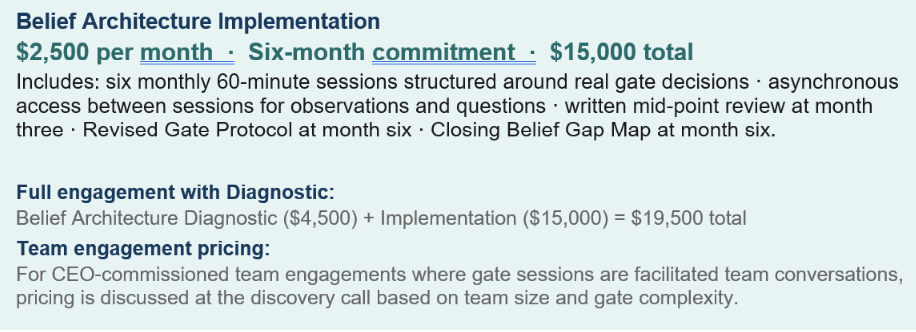
A six-month structured engagement that takes the Belief Gap Map into the stage-gate operating system — redesigning the go/no-go criteria at each decision point to encode the TO beliefs rather than the FROM beliefs that built the ceiling.
Why the Map alone is not enough
The Belief Architecture Diagnostic produces a precise map of where your organization’s operative beliefs diverge from its stated commitments. Most executives who receive that map recognize it immediately. They have felt the gap without having been able to name it.
Naming it is not the same as closing it. Every organization has an operating system that runs on autopilot. In product-making organizations it is the stage-gate development cycle — the series of go/no-go decisions through which an idea becomes a product. In service organizations it is the briefing, scoping, and delivery approval process. In both cases, the operative beliefs governing sustainability outcomes are not in the executive’s awareness. They are in the criteria that govern each gate.
The executive can hold a genuine belief shift personally and the operating system will continue producing the old outcomes — because the system was designed by the old beliefs and runs independently of the executive’s current convictions. This is why Cradle to Cradle design produced better products without changing operating systems: it entered at the Redesign step without examining the beliefs that governed the design criteria. The result was constraints added to an unchanged system. Constraints waive under pressure. The Implementation changes the system.
Six months. Five stages. One revised operating system.
Stage 1 — Gate Audit (Month 1) Map the operating system as it actually runs. Not what the process document says — what the people in the room use when the pressure is real. For each gate or decision point in your product or service development cycle, establish the theory-in-use: what criteria are genuinely non-negotiable, what gets a product killed, what overrides a sustainability concern when the commercial pressure is sufficient.
Stage 2 — Belief Mapping (Months 1–2)
Place your Belief Gap Map alongside the gate audit. For each gate, identify which of the twelve belief pairs is expressed in the current criteria — and which TO beliefs are absent from them. This is the precise diagnosis of where your operating system is running on autopilot against your stated sustainability commitments
Stage 3 — Criteria Redesign (Months 2–4)
Reflect on what the corrected framing requires, then reduce — identify which current criteria express beliefs that cannot be adjusted, only removed. Then develop revised go/no-go criteria that encode the TO beliefs into the decision structure. Not sustainability additions bolted onto existing criteria. Replacements for what expressed the FROM belief, with criteria that would genuinely change the product if they were not met.
Stage 4 — Live Gate Application (Months 3–5) Monthly sessions structured around real gate decisions you have faced or are currently facing. Each decision is read against the revised criteria. Where the operative belief reasserted under commercial pressure, that moment is named and examined rather than absorbed silently. This is the stage where the team naturally enters — gate decisions are team decisions, and the Implementation may expand to include facilitated gate sessions at this stage.
Stage 5 — Revised Gate Protocol (Month 6) The deliverable: a complete, client-specific set of go/no-go criteria for each stage in your development cycle, tested against real decisions, ready to be embedded as the new operating standard. This is what outlasts the engagement — the operating system update, the autopilot reset.
The Revised Gate Protocol
Five gate criteria sets, specific to your operating system, that encode the TO beliefs into the go/no-go decision structure. This is what outlasts the engagement. It is also the document that answers a board or regulator’s governance question: did this organization examine and redesign the beliefs governing its sustainability decisions — and when?
The Closing Belief Gap Map
A second full Belief Gap Map drawn from six months of session material, placed alongside the map produced in the original Diagnostic. The comparison is the evidence of genuine recalibration. It is also the Reposition foundation — the basis from which your organization’s sustainability claims, going forward, reflect what the redesigned gate criteria actually required.
Who this is for
| The Implementation is for the executive who has completed a Belief Architecture Diagnostic and is ready to put the Map to work. It is not available without a prior Diagnostic — the Map is the instrument the sessions work from. It is also for the executive who is responsible for sustainability strategy or brand integrity in an organization operating in EU or UK markets, whose brand has made public sustainability commitments, and who understands that September 27, 2026 is not an abstract future date. The organization that completes the Implementation before that date holds a Revised Gate Protocol and a Closing Belief Gap Map that constitute documented governance due diligence — proof that the Belief Architecture™ governing the decisions was examined and redesigned before enforcement required it. The Implementation is a personal engagement with Ken Alston. It is not a program, a platform, or a group. The number of active Implementation clients at any given time is deliberately small. |
The next step is a conversation, not a commitment.
| If you have completed a Diagnostic and are ready to begin the Implementation, or if you are considering the Diagnostic and want to understand the full arc of the work before you decide — the discovery call is where that conversation happens. It is free. It is thirty minutes. It is the beginning of understanding whether the work is right for your situation. The discovery call is not a sales conversation. It is the first diagnostic step. |