
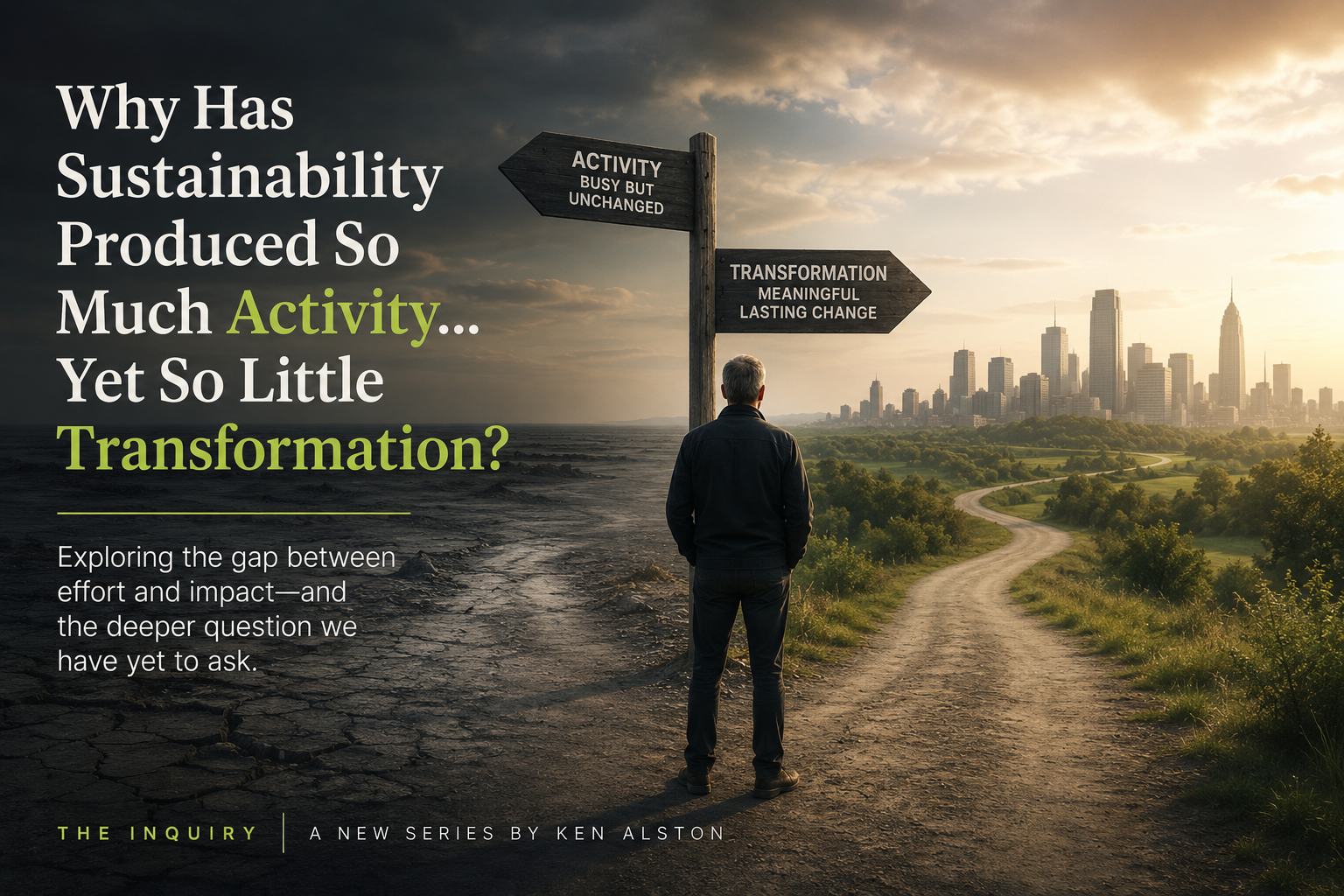
The first essay in The Inquiry.
For more than forty years, one question has guided my work.
Why has business sustainability produced so much activity—and yet so little transformation?
Circularity Edge Intelligence is a reader-supported publication. To receive new posts and support my work, consider becoming a free or paid subscriber.
It is not a question born of disappointment. Nor is it a criticism of the thousands of practitioners who have dedicated their careers to making business more sustainable. I count myself among them.
Quite the opposite.
It is a question born of respect.
Respect for the extraordinary amount of work that has been done.
And curiosity about why the results have fallen so far short of what almost everyone hoped they would achieve.
We achieved more than many people realise
When people talk about sustainability today, there is a tendency to focus on what has not been accomplished.
That is understandable, but incomplete.
During my career I have watched sustainability move from the margins of business into the boardroom.
I have seen environmental reporting become routine.
I have seen product redesign, circular economy thinking, responsible sourcing, renewable energy, and ESG become part of mainstream business vocabulary.
These are genuine achievements.
Thousands of intelligent and committed people have devoted their working lives to making them happen.
They deserve recognition.
But recognition is not the same as understanding.
Because alongside those achievements sits another observation.
The overall trajectory has changed far less than many of us expected.
The pattern I could not ignore
During the last few years, another pattern has become increasingly difficult to overlook.
Companies announcing ambitious sustainability commitments…
…while quietly reducing sustainability teams.
Chief Sustainability Officers disappearing.
Climate targets being softened.
Artificial intelligence increasingly drafting sustainability reports and strategies before anyone has examined the assumptions those strategies are built upon.
Each announcement attracts attention for a few days.
Then another one follows.
Most commentary asks what happened inside that particular company.
I found myself asking a different question.
Why does this pattern keep repeating?
Perhaps we have been looking in the wrong place
For many years I believed the answer lay in better implementation.
Better frameworks.
Better reporting.
Better design.
Better leadership.
Those things matter.
I have spent much of my career helping organizations improve each of them.
But over time another possibility began to emerge.
What if we had been trying to transform organizations without first examining the assumptions governing their decisions?
Not their stated values.
Not their published strategies.
The assumptions operating beneath them.
The assumptions that quietly determine where capital is allocated, how success is measured, which risks matter, and which possibilities are dismissed before they are ever discussed.
That thought became impossible for me to ignore.
The inquiry
The last decade has been an attempt to follow that question wherever it led.
It has taken me beyond sustainability strategy.
Beyond circular economy.
Beyond reporting frameworks.
Into something I had not expected to find.
The hidden assumptions that shape organizational decisions before strategy is ever discussed.
Those assumptions are the subject of my forthcoming book, Our Common Future—Now.
They also led directly to my second book, Perfectly Wrong, which explores what happens when artificial intelligence begins reproducing those same assumptions at machine speed.
Together they ask a deceptively simple question.
What if the greatest barrier to sustainability is not implementation…
…but the beliefs from which implementation begins?
An invitation
Over the next eleven weeks, leading to my keynote at the Real Circularity Summit Live in London, I will explore that question in public.
Not because I claim to have the final answer.
But I believe we have finally begun asking a better question.
If you have ever experienced the gap between genuine effort and limited transformation…
If you have ever wondered why intelligent organizations repeatedly encounter remarkably similar ceilings…
If you have sensed that something deeper has been governing the conversation…
I hope you’ll join me.
The inquiry has taken me forty years.
Perhaps together we can shorten the journey for those who come next.
Continue the Inquiry
For the next eleven weeks, I’ll be exploring this question in public as I prepare for my keynote at the Real Circularity Summit Live in London on September 17 and the publication of Our Common Future—Now and Perfectly Wrong.
If this question resonates with your own experience, I’d value having you along for the journey.
And I’d like to leave you with one question:
Where has your organization made genuine sustainability progress—yet somehow found itself returning to business as usual?
I’d love to hear your experience in the comments.
Next week: When Artificial Intelligence Becomes Perfectly Wrong.
P.S.
If you’re joining us at the Real Circularity Summit Live in London this September, I’d be delighted to continue the conversation in person after my keynote.